The latest edition of Vantage Magazine is available and there's a nice write-up on my old group at Unisys. It's nice to see them in print again - there are some wicked smart folks over there.
There's also some good information on EMC's vision for Information-Centric Security. After all the billions spent on security in recent years ($40B in 2006), less than 20% of companies believe that their information is secure. Firewalls are not enough. This issue provides some insight into how EMC will help solve the problem.
Also - look for the article on Vouching from RSA Labs. I haven't seen this idea anywhere else and it's a nice idea for helping people with lost or forgotten tokens -- without having to burden the Help Desk or use traditional User Self-Service.
Friday, February 2
Friday, January 19
re: Synchronization versus Virtualization
In his entry on Novell’s Cool Blogs, Volker Scheuber discusses the use-cases for virtual directories versus metadirectories and asks for input. Considering my number of previous posts on this topic, I felt an obligation to respond.
I've done a significant amount of services work around both metadirectory and virtual directory technologies. My last company had both and my current company offers neither. The bottom line is that if I were designing an IdM solution, I would want both options to be available. As with any enterprise technology, there's usually more than one way to accomplish a given goal. Most IdM data integration requirements can be met with either meta or virtual technologies. However, there are some scenarios that, for all practical purposes, require one or the other. A while back, I posted some common scenarios where a virtual directory can be really useful.
Even for some of these scenarios though, you may be able to achieve a similar result by standing up another data store and setting up data sync rules with a metadirectory. But it often requires a significant amount of programming that would need to be maintained in addition to the new data store (LDAP or other) and related infrastructure.
Here’s an example:
Let’s say you were deploying a COTS application for insurance claim processing and security is important. The app uses an Oracle database for system data and is built to leverage an enterprise LDAP store (eDirectory, Active Directory, etc.) for authentication. Each employee that needs access to the system already has an account and credentials in the enterprise directory (ED). The system leverages the ED’s groups to grant or deny access. And of course the ED user needs to be enabled.
Due to the sensitive nature of the material, a requirement is made that the system should not allow access to the app unless the employee is punched-in to the company time-clock system. So, if an employee were to piggy back off of a manager’s home VPN connection, they could not access the system unless physically punched-in at work where all claim processing personnel are monitored. The time-clock system has a MySQL database with both system and user data. The APIs for the claim system and the time-clock system are both difficult to work with and complex to maintain.
What are the various ways to meet this requirement?
You could potentially try to work with the API’s and write a custom authentication module that would connect to the time-clock system and verify that a user is punched in before granting access. This would require some internal training, development time and will need to be maintained as either vendor releases new versions in the future.
You could implement a metadirectory solution that sets the ED user as disabled each time status changes in the time-clock system. This may require some custom code, but should be fairly easy to implement. However, we don’t want to disable users in the ED each time they’re punched out. They still need access to HR benefit info and other systems. Not to mention that disabling a user in the ED may trigger other unwanted events to occur (de-provisioning).
You could have the metadirectory solution switch to a different attribute instead of disabling the user, but you’re back to writing a custom authentication module. Also, these metadirectory options will likely introduce some latency because metadirectory sync jobs are typically scheduled. So, there may be some window of time between when the user punches out and when the system denies access. This time window can be exploited to circumvent the intended security controls.
Or – you could have the claims app connect to a virtual directory that is configured to join data from the ED and the MySQL database in a way that is transparent to the claims app. The app sees the virtual directory as an enterprise LDAP directory, but when the user is not punched in, the user appears to be disabled. This is generally a very simple thing to configure for a virtual directory. And if the claims app expects a single group to grant or deny access but the ED groups are arranged differently, the virtual directory can display group memberships however is most appropriate for the app.
Let’s further suppose that the business rules are changed to grant restricted access for the user when punched in but at an alternate location. The virtual directory can be easily configured to set a flag indicating restricted access based on the requestor’s IP address. This is not easily accomplished with a metadirectory solution.
And it’s a plus that the same virtual directory can be used to display user data differently for any number of systems that need access to it – and without altering or moving the data. As we move toward increased regulations and encrypting sensitive data where it lives, reducing the number of data stores that need to be managed and encrypted is an advantage in itself.
Having said all that, I can come up with a number of examples where a metadirectory is clearly a better option than a virtual directory, but I think those are generally easier to see.
Hope this is useful.
Tuesday, January 9
2007: Encryption Everywhere and Phishing Attacks
Encryption Everywhere
In this article from CNET News, Jon Oltsik describes 10 things to know about info security in '07. Number 5 on his list is encryption everywhere. I agree. I admit that I didn't think much about it until joining RSA on the day that it became the security division for EMC, but there's an advancement happening in information security that shifts the focus from perimeter security to information-centric security (an EMC term). Data encryption, therefore, seems to be on everyone's hotlist for 2007. It's about protecting data where it lives -- not just in transit or while being used by a particular app.
Will Sturgeon in his article posted on silicon.com supports the premise that data needs to be protected from inside the perimeter. He quotes Jay Heiser, research VP at Gartner, as saying:
All of this data encryption will present significant challenges for Identity and Access Management professionals as well as application developers. Encrypting data means use of encryption keys which need to be managed. And determining who should have the ability to unencrypt data. And making sure that users who have rights revoked are no longer capable of performing unencryption tasks. It should present a lot of interesting discussions.
Phishing Attacks
Another commonly mentioned priority for 2007 is the prevention of Phishing attacks. For vulnerable organizations, Anti-Phish efforts will be critical.
At RSA's Phishing Reports site, you can download a copy of December's On-Line Fraud Intel Report. A quote from the report:
Here's a place to find more fraud stories from the FBI and NW3C.
Happy 2007!
In this article from CNET News, Jon Oltsik describes 10 things to know about info security in '07. Number 5 on his list is encryption everywhere. I agree. I admit that I didn't think much about it until joining RSA on the day that it became the security division for EMC, but there's an advancement happening in information security that shifts the focus from perimeter security to information-centric security (an EMC term). Data encryption, therefore, seems to be on everyone's hotlist for 2007. It's about protecting data where it lives -- not just in transit or while being used by a particular app.
Will Sturgeon in his article posted on silicon.com supports the premise that data needs to be protected from inside the perimeter. He quotes Jay Heiser, research VP at Gartner, as saying:
"For many organisations, the biggest risk will be insiders, not outsiders. The fact is that a significant amount of proprietary and regulated data walks out the door everyday"In this article from Information Security magazine, Marcia Savage lays out IT priorities for 2007. She points out that in 2007 IT managers will shift toward focusing on the inside threat.
All of this data encryption will present significant challenges for Identity and Access Management professionals as well as application developers. Encrypting data means use of encryption keys which need to be managed. And determining who should have the ability to unencrypt data. And making sure that users who have rights revoked are no longer capable of performing unencryption tasks. It should present a lot of interesting discussions.
Phishing Attacks
Another commonly mentioned priority for 2007 is the prevention of Phishing attacks. For vulnerable organizations, Anti-Phish efforts will be critical.
At RSA's Phishing Reports site, you can download a copy of December's On-Line Fraud Intel Report. A quote from the report:
The number of institutions coming under attack rose to an all-time high the final month of the year, surpassing the previous high of 195 set in July. This was largely a result of fraudsters stepping up the use of security-upgrade-related cover stories in advance of the FFIEC guidance deadline in the U.S. That said, the number of brands being phished is not expected to fall off markedly in Q1 ’07.That's nearly 200 different organizations in a single month reporting phishing scams. That means that someone you know is likely being phished for information (if you're in the U.S.).
Here's a place to find more fraud stories from the FBI and NW3C.
Happy 2007!
Monday, January 8
Yikkes! Bad Security
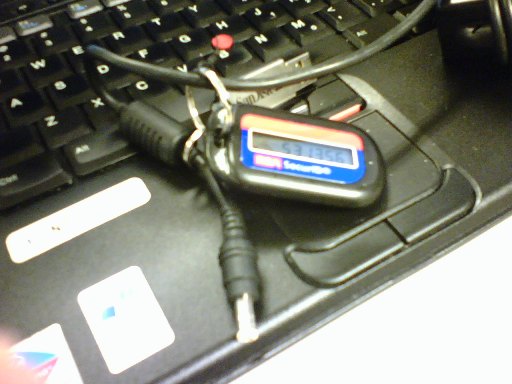
Dave Birch (Hyperion) posted about an administrator at a large financial firm who encourages his user population to tether their RSA SecurID tokens to their laptops. All I could really say is Yiikes! ...and I don't think I've ever used that word before. Imagine the look on his or her face when the CIO (or other IT manager) who approved the 2-factor authentication project in order to achieve greater security got that email.
 Apparently, some of the employees of this organization complained about having to carry a token with them. I can understand that, but there are certainly other options -- think Blackberry or Mobile Phone token, software token, browser toolbar token, just to name a few. And even the latest token design is less bulky on your key chain if you elect to stay with physical tokens.
So, if this message gets back to the SecurID administrator who posted that message, please reach out to us. We can make life easier AND more secure. It's not an either-or scenario. These users can install a soft token on their mobile device and then leave their hardware token at home where they use it most.
The proposed tethered-token solution really minimizes the organization's security investment. And I can only guess that this practice would have a negative affect on a security or compliance audit.
[Addendum: Dave was pointing to another article.]
 Apparently, some of the employees of this organization complained about having to carry a token with them. I can understand that, but there are certainly other options -- think Blackberry or Mobile Phone token, software token, browser toolbar token, just to name a few. And even the latest token design is less bulky on your key chain if you elect to stay with physical tokens.
So, if this message gets back to the SecurID administrator who posted that message, please reach out to us. We can make life easier AND more secure. It's not an either-or scenario. These users can install a soft token on their mobile device and then leave their hardware token at home where they use it most.
The proposed tethered-token solution really minimizes the organization's security investment. And I can only guess that this practice would have a negative affect on a security or compliance audit.
[Addendum: Dave was pointing to another article.]
Wednesday, January 3
Some Identity and Password Reading
As Ash already mentioned, Jackson Shaw is now blogging. I remember Jackson from a time when MIIS was my tool of choice. He's been doing the identity thing for a while, so he might be worth a read.
Here's a few other useful articles I've recently come across:
- 9 Perfect Password Pointers - In case someone you know needs a reminder (you know, the person writing the password policies)
- Identity Management and Protection: A Key Differentiator? - Yeah, it's not just for CYA any more!
- Provisioning/User Management System Upgrades: Part Two Building Awareness And Building Approval - A little help making the business case is always appreciated.
- Most play poorly at the password game - Moral support for those who think passwords are painful to manage.
...I guess that's all I've got right now.
Wednesday, November 22
Single Sign-On; Multiple Confusion Points
The Identity Management landscape is littered with various products. It's already difficult to understand IdM product categories and how they work together. But it's made worse because various vendors implement their technologies differently. That's not necessarily a bad thing in itself, but customers are confused.
The problem is analogous to that of Microsoft's Internet Information Services (IIS). IIS is both a web server and an application server. So, in a chart, it would line up against the Apache and Sun web servers. But, it would also line up against Tomcat, WebSphere and WebLogic in the application server category. This same phenomenon occurs often with Identity Management products. Some products have single capability and others have multiple. Some companies offer a single product and others offer multiple. So, it becomes very difficult to compare apples to apples.
In protest of all this confusion, I continue to attempt to simplify the IdM landscape. A while ago, I tried to create an identity services architecture map that could be used as a visual aide when communicating about where products fit in to an overall IdM architecture. While not 100% satisfied with it, I do think it serves the basic purpose.
Lately though, I've been re-thinking Web SSO and Enterprise SSO. What I've found is that people tend to group them together. However, at their core these are two very different technologies.
Web SSO is about securing access. It's generally implemented as a web server filter that intercepts access requests and makes decisions about whether to grant or deny access to the requested resource for the requesting party. Strong Web SSO products typically include a mechanism to manage web resources and user access permissions.
ESSO, on the other hand, is about enabling a better end-user experience. Typically, ESSO is implemented as a desktop client that manages user credentials on behalf of a single user. There are some ESSO implementations that act as an access proxy somewhere on the network, but this functionality isn't core to ESSO capabilities. The main driver of ESSO tends to be end-user experience and not security. In fact, I often hear the ESSO question from customers posed something like this:
So, I guess I'm thinking that I might move ESSO out of the Access Services layer and into the User Services layer. It's really not doing any enforcement and it's not managing policies or access rights. It's really only fostering a better user experience in a secure way.
And let's just all start ignoring the term Reduced SSO. This term just acknowledges that not every enterprise system can participate in an SSO implementation. Is this really necessary to distinguish? We're looking to achieve single sign on for participating applications. Let's not confuse customers further with an additional term that only points out what should already be obvious. If we can make this all simpler, I think we'll see higher adoption (and success) rates and happier customers.
The problem is analogous to that of Microsoft's Internet Information Services (IIS). IIS is both a web server and an application server. So, in a chart, it would line up against the Apache and Sun web servers. But, it would also line up against Tomcat, WebSphere and WebLogic in the application server category. This same phenomenon occurs often with Identity Management products. Some products have single capability and others have multiple. Some companies offer a single product and others offer multiple. So, it becomes very difficult to compare apples to apples.
In protest of all this confusion, I continue to attempt to simplify the IdM landscape. A while ago, I tried to create an identity services architecture map that could be used as a visual aide when communicating about where products fit in to an overall IdM architecture. While not 100% satisfied with it, I do think it serves the basic purpose.
Lately though, I've been re-thinking Web SSO and Enterprise SSO. What I've found is that people tend to group them together. However, at their core these are two very different technologies.
Web SSO is about securing access. It's generally implemented as a web server filter that intercepts access requests and makes decisions about whether to grant or deny access to the requested resource for the requesting party. Strong Web SSO products typically include a mechanism to manage web resources and user access permissions.
ESSO, on the other hand, is about enabling a better end-user experience. Typically, ESSO is implemented as a desktop client that manages user credentials on behalf of a single user. There are some ESSO implementations that act as an access proxy somewhere on the network, but this functionality isn't core to ESSO capabilities. The main driver of ESSO tends to be end-user experience and not security. In fact, I often hear the ESSO question from customers posed something like this:
We want ESSO to make users' lives easier, but we're afraid of the security implications. If a password is compromised, an attacker would now have access to the entire kingdom.My answer is that this problem isn't with ESSO -- it's a problem with the authentication mechanism. Two-factor authentication would prevent an attacker from accessing anything with just a password compromise. And ESSO enables strong password policies on applications throughout the enterprise, which means passwords are much less likely to become compromised in the first place. If users don't ever need to remember or manually enter their passwords into systems, you could reasonably require 10 character passwords which require upper, lower, numeric and special characters. And you can force a password change every 30 days (this can also be transparent to the end-user). This creates a password that's much more difficult to guess or brute-force attack than a typical user's 6- or 8- digit alpha-numeric password.
So, I guess I'm thinking that I might move ESSO out of the Access Services layer and into the User Services layer. It's really not doing any enforcement and it's not managing policies or access rights. It's really only fostering a better user experience in a secure way.
And let's just all start ignoring the term Reduced SSO. This term just acknowledges that not every enterprise system can participate in an SSO implementation. Is this really necessary to distinguish? We're looking to achieve single sign on for participating applications. Let's not confuse customers further with an additional term that only points out what should already be obvious. If we can make this all simpler, I think we'll see higher adoption (and success) rates and happier customers.
Tuesday, October 24
Convergence of Physical and Logical Security
In my very first blog entry back in February, I wrote briefly about the convergence of physical and logical security. I didn't know much about the topic at the time, but I had a feeling that it was important. The entry is unfortunately a fairly uninteresting and un-informative piece of writing, but it seems to continuously generate a significant amount of activity to my blog. And it's not just me - I'm starting to see articles pop up everywhere that the security discussion is taking place. It's a hot topic.
Throughout 2006, it has become more and more obvious that this convergence is a vital part of securing the enterprise. Since joining RSA on the first of this month, the number of convergence conversations I've been a part of has definitely increased. RSA offers smart cards and card management software that enable organizations to deploy a single authenticator that stores multiple credential sets for use across both physical and logical security. So, that's probably why I'm hearing more about it.
If you're interested in learning more about RSA's offering, take a look at this webinar: The Future of Authentication
I unfortunately don't have any new insights to offer on this topic, but I thought it was simply worth saying that if you're responsible for securing an organization, you ought to be thinking about this. And to put together some info on the topic since people seem to be coming here for info.
A few related articles:
- CSO Fundamentals: ABCs of Physical and IT Security Convergence, CSO Online
- The Convergence of Physical and IT Security, by Fran Howarth (Sept. 11, 2006)
- Security Convergence, by Thomas Hoffman (Feb. 13, 2006)
- The Convergence of Logical and Physical Security Solutions, by Brian T. Contos
- Ten Steps for Assisting Malicious Insiders, by Brian T. Contos
Friday, October 6
First Week at RSA
I had an interesting and busy first week at RSA. It's no surprise that I met some extremely bright people. I spent my first few days in Phoenix working with an internal team and managed to speak with a few customers as the week progressed. Some of the very cool ideas I've already heard include:
- Providing Network Access Control using machine certificates. The idea here is that you can't plug in a machine without a proper cert and gain access to the network. RSA has certificate management software that makes this solution a reality. The cert can be based on a specific hardware profile so getting your hands on the cert won't help. It's simple and effective.
- Risk-Based access control or what RSA calls Adaptive Authentication. This is about adding an additional dimension to the authentication process. Not just what you have and what you know, but where are you right now? Or from which device are you attempting to gain access?
- The business value of implementing Federation as a way to reduce bandwidth on the LAN. It never even occurred to me until one of my new colleagues pointed it out. Why tie up your global WAN with unnecessary packets (and spend your budget on increasing infrastructure) when you can leverage the web to pass access rights to overseas applications using a simple Federation solution?
- RSA also has a nice key management utility for organizations that need to build encryption into software solutions but don't want to assume the burden of: 1) designing a secure encryption solution. 2) securing the encryption keys for use by the solution. Or worse yet 3) managing the on-going key life cycle. Keys can be shared amongst applications and re-generated on a schedule to reduce the risk of the keys being compromised.
Needless to say, I'm already getting very busy. I have a lot to do and I have to say I'm invigorated by the new challenges. ...until next time.
Subscribe to:
Posts (Atom)